
Meanwhile in Czechia... 12/26
27.03.2026
Radio Prague facing the end?
 According to Foreign Minister Petr Macinka, the international stations of Czech broadcaster Český rozhlas are to be abolished. Next week, the minister wants to sign a new contract with the broadcaster, whose foreign radio stations are financed by the Ministry of Foreign Affairs, regarding funding for this year. According to the agreement, the broadcaster would only receive just over 26 million crowns instead of the planned 35 million. In 2027, the minister would like to stop funding completely. He considers the broadcaster to be superfluous. During a TV interview, it emerged that the minister thought the channel was for Czechs living abroad. However, the multilingual stations (in English, German and French, among others) are listened to by people who do not speak Czech and who are interested in the Czech Republic. The foreign stations are therefore a form of advertising abroad. According to Český rozhlas, around 8 million people visited the international websites last year, most of them from Germany, France, the USA, Austria, Spain and the UK. The programs are listened to most in English, German and French. An end to financial support would also mean the end of the foreign broadcaster, which is celebrating its 90th birthday this year.
Whether financial support will be discontinued now depends on the Czech parliament's media committee. According to media reports, the possible abolition of foreign broadcasters has met with opposition from members of the ruling ANO party. The opposition parties are already criticizing the undertaking.
Public broadcasting in the Czech Republic is currently under immense pressure. The government wants to drastically cut funding, abolish fees and finance broadcasting directly from the state budget. The main drivers are the two small parties in the government, the radical right-wing SPD and the motorists, whose share of the vote in opinion polls is currently below the 5 percent threshold.
Mass protest in Prague
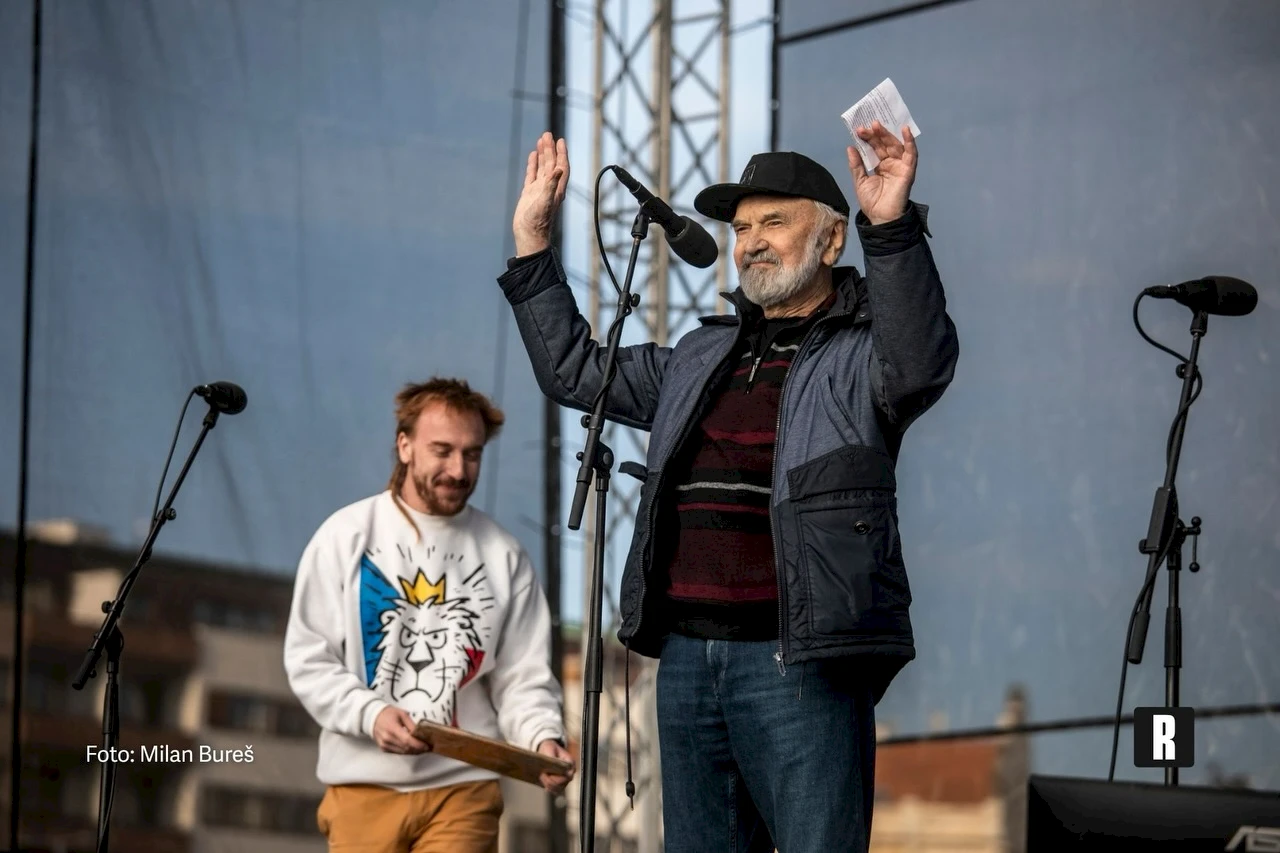
Almost a quarter of a million people protested against the current Czech government in Prague last Saturday. The demonstration in Letná Park was held under the slogan "We will not allow our future to be stolen" and accused the government of corruption, abuse of power, abolition of institutions and the introduction of the manners of Eastern European autocrats. Above all, the demonstrators fear an erosion of democratic institutions and complain about the aggressiveness of the two small governing parties in particular. The demonstration was called by the association "Milion chvilek pro demokracii" (One million moments for democracy). Speakers included well-known actors such as 90-year-old actor and screenwriter Zdeněk Svěrák ("Kolja"), actor Ondřej Trojan and singer Aneta Langerová.
Letná Park is the venue for large demonstrations in the Czech Republic. A similarly large demonstration in 2019 heralded the end of the first government. The Milion chilek association is independent of political parties and politicians and relies purely on civil society. The largest demonstration in the history of the Czech Republic and Czechoslovakia to date also took place in Letná Park. In 1989, at the height of the Velvet Revolution, 750,000 people from all over Czechoslovakia demonstrated here.
Tysza walls restrict access
Anyone planning an Easter trip to the Tiské stěny (Tysa Walls) should leave nothing to chance. Otherwise, you might end up in Tisá but only be able to see the walls from afar. With the start of the new excursion season on April 1, the municipality will only allow a maximum of 2,000 people a day into the popular rock world. On days with many visitors, such as Easter, it can therefore happen that it is simply sold out.
It is nothing new that admission to the Felsenwelt costs money. Tickets are available from small sales booths at the two entrances. A ticket for adults currently costs 100 crowns, which is just over 4 euros. Children up to the age of 15, students up to the age of 26 and senior citizens over the age of 65 only pay half price. There is also a family ticket for up to three children for 250 crowns. Children under the age of 6 pay nothing.
However, even early risers could come away empty-handed, as the municipality has launched an online ticket system. So if you want to be on the safe side for your Easter trip, you should buy your tickets here. The ticket platform also shows how many tickets are still available. For Easter Sunday, all 2,000 tickets are currently still available. The platform has a Czech, German and English language version.
Incidentally, the municipality of Tisá is planning regular ticket checks. The area is not fenced in, which is why resourceful visitors could cheat their way past the entrance. The municipality wants to prevent this and will have two to three people on site regularly to check the area.
Restrictions on visits to popular excursion destinations have increased in recent years. This first happened in the Adršpach rock world, a similarly fascinating landscape to the Tyssa Walls, only bigger. In Bohemian Switzerland, limited ticket sales for the Edmund Gorge (Edmundova soutěska) have been available since last year. This is due to the destruction caused by the forest fire four years ago. However, the municipality of Hřensko, which owns the paths in the gorge and organizes the boat trips, would like to maintain limited access in the future, albeit with a higher number of people per day as soon as possible.
Less beer from Velké Březno
The Dutch brewing group Heineken has announced that it will be brewing less beer at its brewery in Velké Březno (Großpriesen) in future. The background to this is the falling demand for beer, not just in the Czech Republic but worldwide. The group wants to cut 5,000 to 6,000 jobs worldwide. No employees are to be made redundant in Velké Březno, according to reports. However, there will be no more brewery tours until further notice.
 This is a hard blow for the region. Following the takeover, Heineken had already closed the Zlatopramen brewery in Ústí nad Labem (Aussig) in the Krásné Březno (Schönpriesen) district there. The popular Březňák beer is brewed in Velké Březno and is also exported to Germany.
The beer is best known for its logo. Since 1906, it has been adorned with the likeness of former railroad employee Viktor Cibich (1856-1916). His identity was discovered by Vladimír Kaiser, the former head of the Ústí nad Labem municipal archive, through lengthy research. Kaiser also eventually found Cibich's grave. The well-fed and contented Cibich was even a role model for other logos abroad. Cibich could be well-fed and content simply because he was granted a lifelong beer pension in return. So he got his beer for free in the local pubs.
Association saves ballroom in the Schicht factory
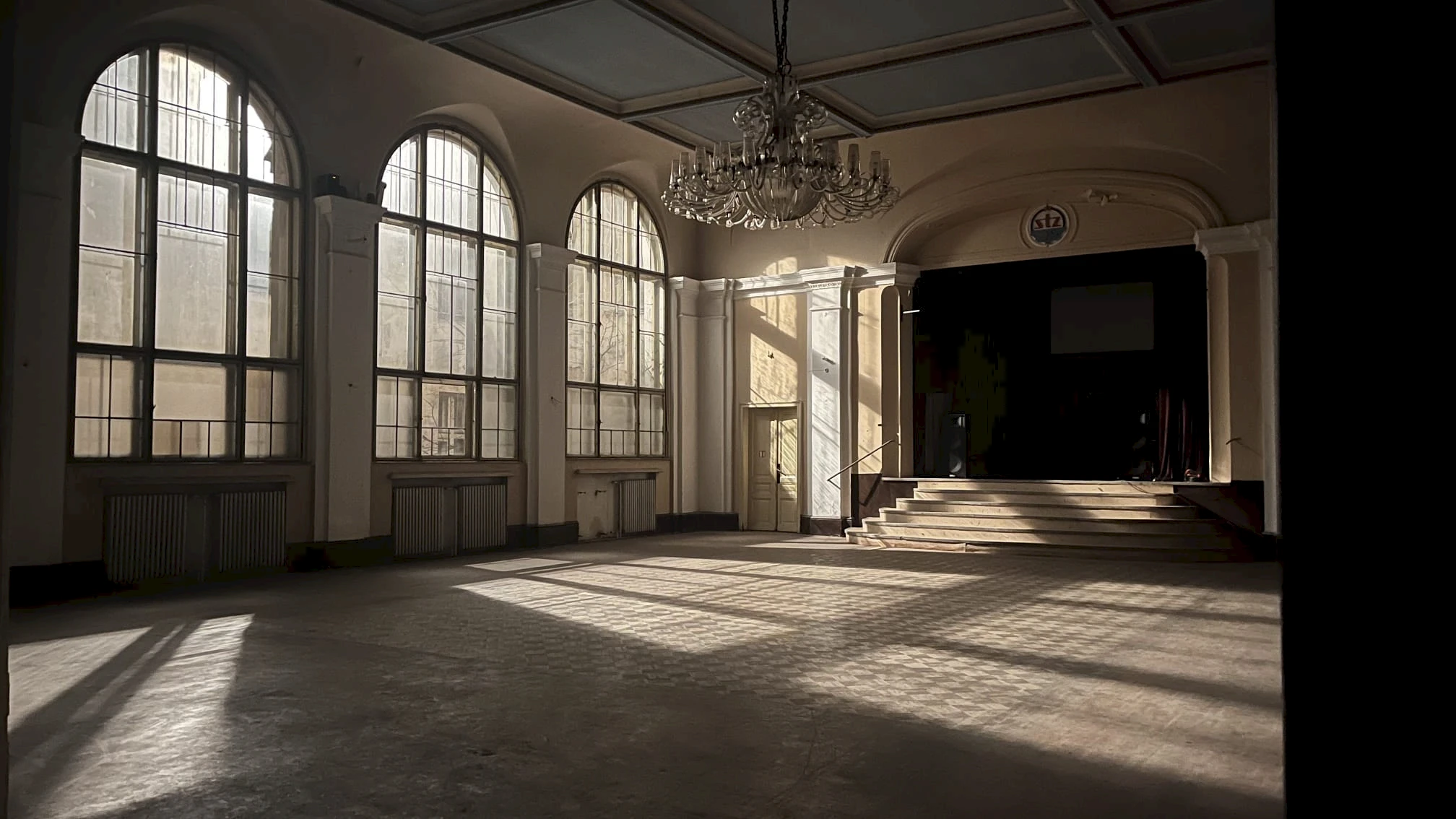
The historic ballroom of the Schicht factory in Ústí nad Labem in the Střekov district is reopening. A photo exhibition will open on Saturday where generations used to dance. The exhibition is a charity event to save the ballroom. Among other things, motifs of the administration building of the famous Schicht-Werke with its opulent ballroom will be on display.
A few years ago, however, this historic building seemed to have come to an end. Where the Schicht family began producing soaps in the 19th century, one of the largest factories in the monarchy quickly emerged. In addition to soaps, magarine and other drugstore products were also manufactured. The soap with the deer (Jelen) logo was famous. This is the birthplace of today's global corporation Unilever. After 1945, however, the factory in Ústí was nationalized, but it continued to produce until the 2010s. Then the plant was split up. Today, neither soap nor margarine is produced here. The administration building has been empty since 2011 and was due to be demolished three years ago. Part of it was demolished and one wing had to go. However, the older part with the ballroom was placed under a preservation order. The Střek-ON association was therefore able to convince the owner to rent out the hall.
After a year, the time has now come to inaugurate the hall with a vernissage. Admission costs 70 euros for two people. The proceeds are earmarked for the sensitive renovation of the hall and its continued operation. After the vernissage with music and dancing, which starts at 3 pm, the party will continue until 10 pm. The hall will also be open all day on Sunday. More information at Sál Šichtovka.
Czechs switch to public transportation due to petrol prices
Rising prices for petrol and especially diesel have now also reached the Czech Republic. According to a report in the daily newspaper Mladá fronta Dnes (MfD), this is now making itself felt in transport behavior, including in the Ústí district. Capacity utilization has increased, especially on bus routes that connect smaller towns with cities. The district, which orders the journeys, does not have any reliable figures. However, the newspaper relies on statements from passengers and bus drivers. According to them, some connections are much busier than two weeks ago, especially during rush hour.
According to researcher Hana Brůhová Foltýnová from the University of Ústí nad Labem (UJEP), commuters who can switch to public transport, which is regular, predictable and, above all, has a journey time comparable to that of a car, are therefore the first to switch from car to bus or train. However, she does not expect a large number of car drivers to switch to public transport. Experience shows that for every 10 percent increase in prices, 1 to 4 percent of car users will switch.
Petrol and diesel prices are now significantly higher than they were weeks ago. Petrol costs an average of 1.75 euros per liter, diesel 1.95 euros. This means that the old gap between German and Czech prices of a good 30 cents has almost been restored.
Prices in the Czech Republic initially rose more slowly than in Germany because the state kept prices low through its company Čepro. Čepro operates the Eurooil and Robin Oil networks with almost 300 petrol stations, which already represents a small market power. Industry Minister Karel Havlíček had instructed Čepro to continue selling fuel at the same prices as before the attack on Iran. In Germany, on the other hand, petrol station chains immediately raised prices, although the state does not have a stake in any petrol stations here either.