

Fürstenau madonna and chapel in Přední Cinovec
Video: Jan Kvapil (script, text), Jiří Bálek - LEMURIA TV (film), Euroregion Elbe/Labe
Unfortunately, the sign with the QR code is no longer there. The particularly harsh effects of time in the Ore Mountains have taken too heavy a toll on it. But a replacement will soon return at the shelter currently under construction nearby.
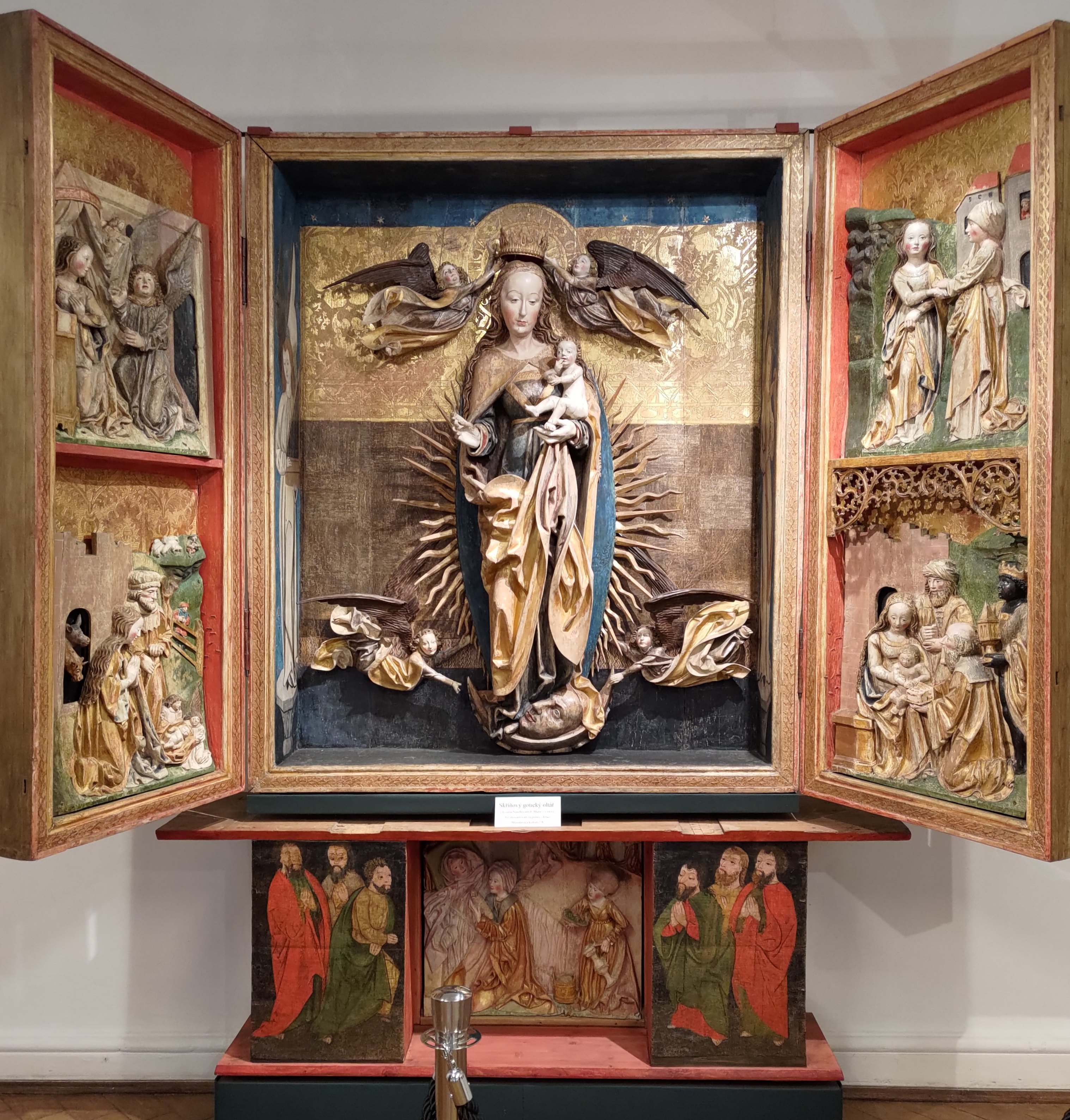
The Fürstenau Madonna Altar has had an eventful history, one that is closely intertwined with Saxon-Bohemian relations in the border region. The details of this history will be published later, so here is just a brief overview: The late-Gothic altar likely originated in Pirna and was subsequently housed for many decades (or rather, centuries) in the church in Fürstenau. After pilgrimages in Austria-Hungary—and thus also in Bohemia—were severely restricted in the 18th century under Emperor Joseph II, the residents of Vorderzinnwald and other nearby towns found an alternative: they made pilgrimages to the Madonna Altar in Fürstenau, which was located in a Protestant church. This was not without conflict. When the church in Fürstenau was rebuilt in 1887, there was no longer room for the altar, so it was donated to Vorderzinnwald. There, just a few meters from the border, a chapel was built to house it. This chapel was demolished after the expulsion of the Germans following World War II. The altar eventually found its way, via various detours, to the Regional Museum in Teplice.
If you take a look at the altar in the museum in Teplice, you’re sure to be impressed by the craftsmanship and vitality of the carvings. It therefore has not only historical value but also great artistic value.
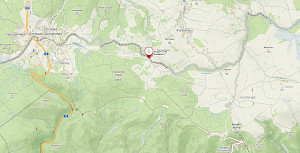
For both of these reasons, the Elbe/Labe Euroregion was committed to making the altar and the chapel accessible again on site. Since reconstruction was out of the question, we have brought both back to life in virtual form. At the site of the former chapel (see map) in Vorderzinnwald, you can use a smartphone or tablet to view the altar and the chapel in the landscape as if they were still there (so-called augmented reality). You can get very close to the altar and examine its details in 3D. The video above demonstrates this very clearly. You can find more details about the project below.
The project
Work on the project began in November 2021. To create the 3D representation, a 3D model of the Madonna Altar in the museum in Teplice was produced using laser scanning. This was supplemented with high-resolution photos.
However, the chapel had to be virtually reconstructed in a different way, since it no longer exists. Here, a 3D model was constructed based on old photographs and rendered with appropriate textures. As a result, the chapel looks less realistic than the altar. Nevertheless, it still gives a good impression of how it would have appeared in the landscape.
Ultimately, both models had to be published online so that they could be experienced via so-called augmented reality—that is, as accurately positioned overlays on the camera view of a cell phone or tablet. No separate app installation should be necessary for this; instead, everything should be accessible directly in the browser. This is made possible by the relatively new WebAR technology, which, unfortunately, is not yet supported by all browsers. Safari on Apple devices, in particular, is still lagging behind in this regard. The experience is therefore somewhat limited on these devices.
On the information board next to the chapel’s former location, there is a QR code that leads to a page from which you can launch the application for the 3D experience. This requires downloading some data, which may take a little longer on-site depending on cell service. Once the download is complete, you can point your device toward the chapel and see it superimposed in the camera view at the spot where it once stood. You can approach it or walk around it to view it from all sides. If you get very close, the image fades away and the Madonna altar appears in the landscape instead. You can now examine this in great detail from all sides as well.
The “Madonna Altar in 3D” project was supported with funds from the European Union’s Small Projects Fund in the Elbe/Labe Euroregion.
