
Meanwhile in Czechia... 14/26
10.04.2026
Price cap for fuel in the Czech Republic
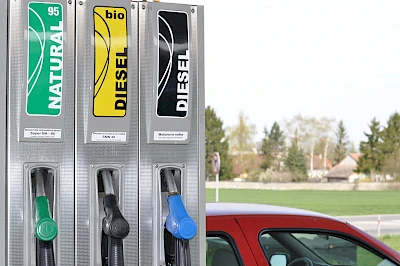
The regulation on maximum fuel prices adopted by the Czech government on April 2 was applied for the first time on Tuesday. Since then, the government has been setting the maximum prices for petrol and diesel every day at 2 p.m., which will apply the next day (or over the weekend). The fixed prices are based on market data, in particular wholesale prices. The actual restriction is that a profit margin of CZK 2.50 per liter may not be exceeded for normal fuels. At the same time, taxes on fuel were reduced by CZK 2.35 per liter.
On Tuesday, the maximum prices for Wednesday were set at CZK 43.15 (€1.77) per liter for petrol and CZK 49.59 (€2.03) for diesel. For the weekend and Monday, CZK 41.95 (€1.72) and CZK 45.90 (€1.88) per liter were announced today on the website of the Ministry of Finance. There you can also find a hypothetical price without regulation, with which the government apparently wants to pat itself on the back.
State treaty with the Vatican is unconstitutional
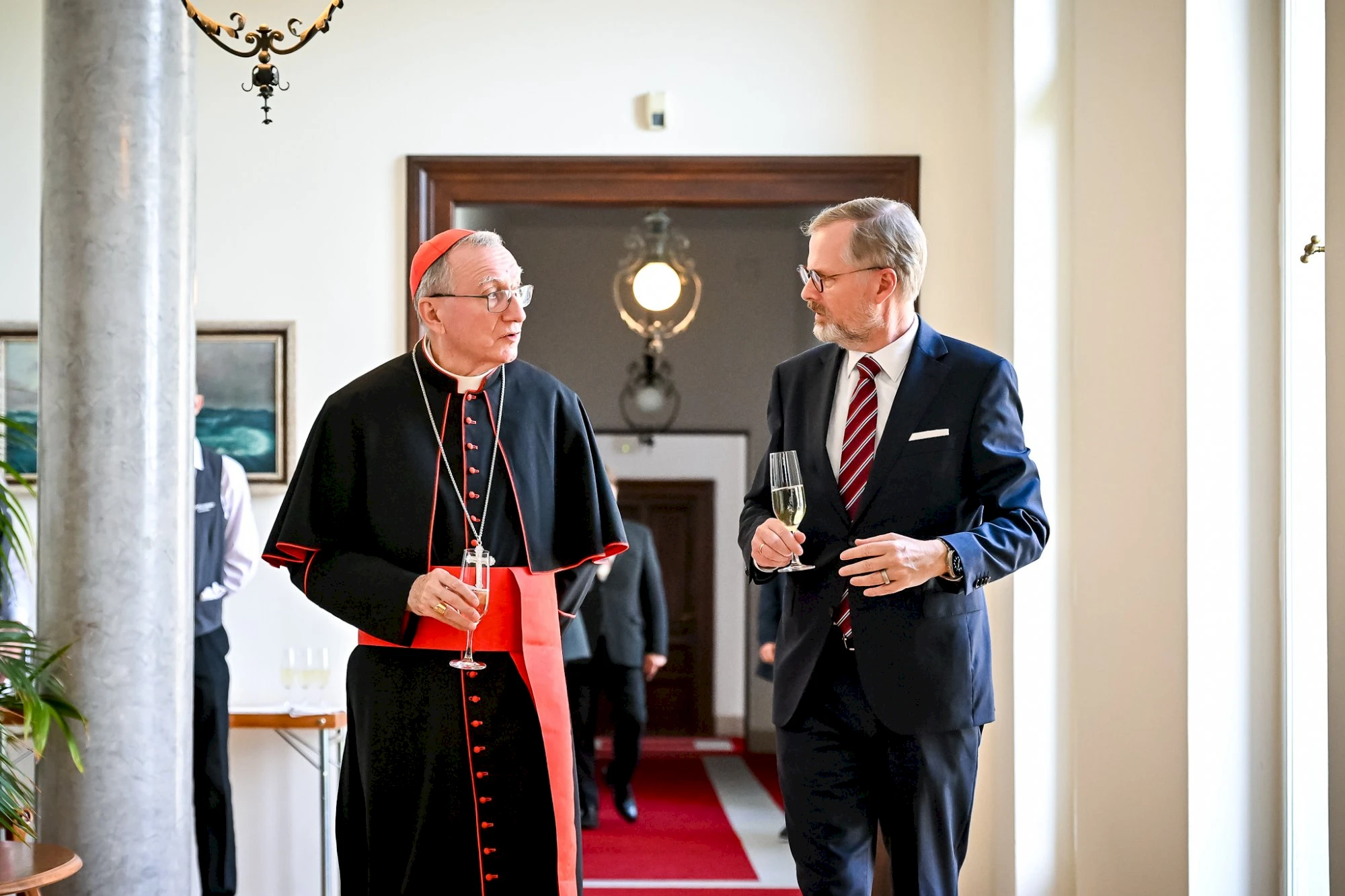
The Czech Republic is one of the last countries in Europe to conclude a state treaty with the Vatican in 2024 to regulate relations. However, this must be ratified by the Senate, Parliament and the President. The first two steps have been taken, but some senators have submitted it to the Constitutional Court for review on eight specific points. The court ruled last week that two of these were not compatible with the Czech constitution.
One of these concerns the confidentiality of confessions, which according to the treaty should apply to Catholic priests without restriction, while it is restricted for other religious communities. For example, the latter would have to report if someone announced a serious crime in confession, which Catholic priests would not be obliged to do. The second point concerns restrictions on access to the archives of the Catholic Church.
Ratification cannot be completed due to the ruling. It is now up to the new government to negotiate an amended version of the treaty with the Vatican.
Czechs view many countries more positively
The renowned Czech opinion research institute STEM has been conducting a survey on the Czech public's attitude towards various other countries for many years. For 2025, this shows a slight increase in sympathy ratings for many European countries. Respondents rate their personal attitude with school grades from 1 to 5. The evaluation then refers in particular to the proportion of those who awarded grades 1 and 2.
The frontrunner in 2025 was Austria with 71% (grades 1 and 2), closely followed by Switzerland (69%), Italy and Poland (68% each) and Slovakia (67%). Germany ranked in the middle of the pack with 54% and formed a close group with Slovenia, France, Belgium, Japan and the UK.
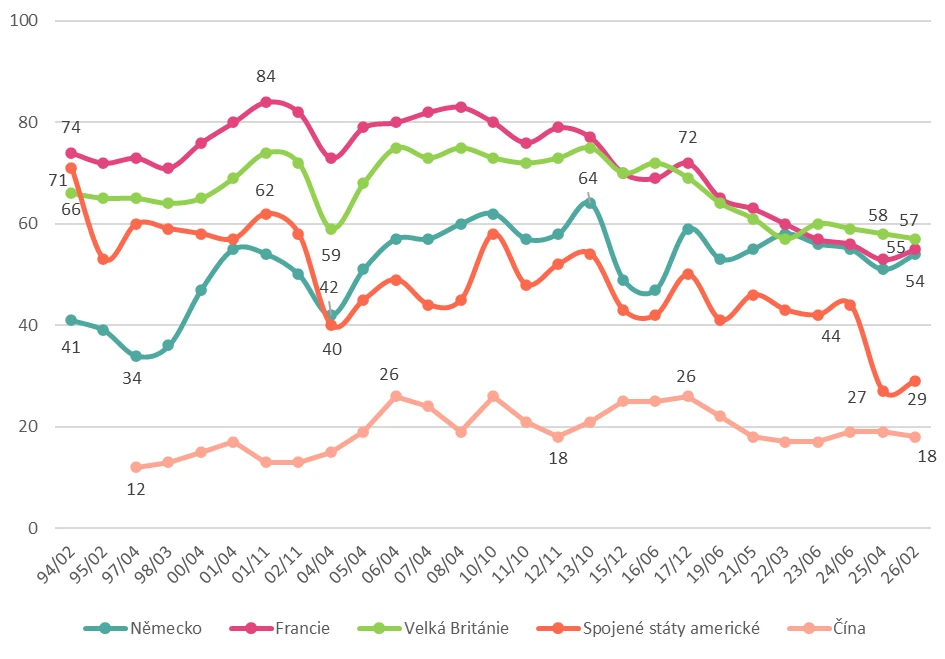
The study is particularly interesting when looking at longer time series (see chart). For example, a clear downward trend can be seen for the USA (orange line) since 1994 and for France (burgundy) and the UK (green) since around 2012. For Germany (turquoise), on the other hand, the trend has been slightly upwards since 1994, albeit with very strong fluctuations that often reflect current political developments. For all four countries, for example, there was a sharp dip in 2004 and a somewhat lighter one in 2015/2016.
With regard to the Visegrád states (Czech Republic, Poland, Slovakia, Hungary), it can be seen that, on the one hand, Hungary is far behind at 40%, while on the other hand, Slovakia's popularity has been falling significantly for around 10 years, while Poland's has risen considerably in the last five years.
The survey not only evaluates countries, but also internationally important personalities. Pope Leo XIV takes the top spot, followed by Emmanuel Macron and Karel Nawrocki. Interestingly, Friedrich Merz also did quite well, coming in fifth place, although he was unknown to 36% of respondents. Among those who knew him, he enjoyed similar popularity to Macron.
Mercedes-Benz Trucks invests in Cheb
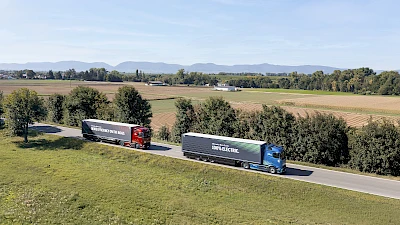 Last week, Mercedes-Benz Trucks announced plans to build a new truck assembly plant in Cheb. This will have a production capacity of 25,000 vehicles per year. Around 1100 new jobs are to be created. Mercedes plans to invest around 300 million euros and start production by 2030. This is an enormously important project for the structurally weak region, which will significantly reduce unemployment, which is above the national average, but will also increase wage levels, which are below the national average.
Successful fundraising campaign for attack victims
On January 19, a man shot and killed janitor Libor Cicvárek in the municipal administration of Chřibská (Kreibitz) in the Schluckenauer Zipfel and injured six people(we reported). He then shot himself. The Ústí district had launched a fundraising campaign for the relatives of the victim and the injured, which ended this week. Around CZK 1.1 million (approx. EUR 45,000) was collected from 499 donations from private individuals, municipalities and other legal entities, as has now been announced. By decision of the Ústí District Council, the wife of Libor Cicvárek will receive CZK 500,000, his two sons CZK 250,000 each and the injured CZK 25,000 each.
Hejtman Richard Brabec also proposed to Czech President Petr Pavel that Libor Cicvárek be awarded the Hero Medal in recognition of the fact that, despite the danger to his life, he provided first aid to the seriously injured mayor, protected female colleagues from the attacker and warned a colleague by telephone while he was still dying, which probably saved his life.