

Weekly review no. 6
03.11.2023
VW moves battery factory in Czech Republic
Volkswagen is not building its gigafactory planned in Central Europe for the time being. The group cited the slower development of electromobility as the reason. Volkswagen's decision is, above all, against the Czech Republic. That's where the negotiations were most advanced. Recently, the Czech government pushed Volkswagen to speed up. The Czech Republic had prepared a plot of land in Líně, near Plzeň Airport. The property is conveniently located close to the D5 Prague-Plzeň-Regensburg motorway. On Monday, CEO Oliver Blume met Prime Minister Petr Fiala and gave him the bad news.
The decision is only about not tackling the battery factory now, but later. VW is sticking to its three other planned factories in Germany, Spain and Canada. But in the Czech Republic the news was received as a serious setback. Industry Minister Jozef Síkela emphasized that the government is currently negotiating with five additional investors. Of these, two projects would be the size of what Volkswagen planned, two would be medium-sized and one project would be smaller. Síkela did not name names.
The vice president of the Industry and Transport Association Radek Špicar does not believe that this decision will set the Czech Republic back, but said on Czech television Česká televize: "The automotive industry is going through a dramatic, complicated and expensive transformation towards alternative drives. It would be important to do so to get an investment, also in view of the fact that we want to mine and process lithium in the Ore Mountains." He also pointed out that the Czech Republic had lost its former location advantage of cheap and sufficiently available workers. In addition, energy prices in the Czech Republic are now higher than in Poland or Hungary. The government must work on these problems.
The Ústí district had also long had hopes of setting up a gigafactory in northern Bohemia, near Saxony. Whether the VW decision increased the chances for the location near Prunéřov near Kadaň was initially not an issue.
New wind power rules in the Ústí district
The Ústí District plans to adopt a new policy on the construction of wind turbines. The Supreme Administrative Court declared this part of the principles of regional planning to be invalid a few weeks ago. The previous regulation had made the construction of wind turbines almost impossible. Plaintiffs, however, successfully sued for discrimination. Other construction projects are not subject to such strict regulations. Municipalities, private individuals and companies had sued. The district also did not take public interest in renewable energies into account enough.
The Ústí district wants to develop the new principles within the next few months and adopt them this year. Nature conservation remains the top criterion against the construction of wind turbines, which is why nature conservation organizations and the Ministry of the Environment should be involved in the reformulation process. However, it is foreseeable that a future regulation will open the way to more wind turbines, but uncontrolled growth should be prevented, it is said.
There are a total of 50 wind turbines in the Ústí district, a quarter of all wind turbines in the entire Czech Republic. Almost all wind turbines in the Ústí district are located at high altitudes in the Ore Mountains.
Hřensko charges a tourist fee
Starting next year, overnight guests will have to pay 20 crowns per night in Hřensko (Herrnskretschen). The local council decided this. The border village hopes to compensate for the loss of income that has torn a deep hole in the community's coffers due to the closure of the Edmundsklamm. The income from parking fees is unchanged. But overall the income is only a third compared to a normal year with the Edmundsklamm open.
The accommodation fee is collected by hotels and guesthouses and passed on to the municipality. However, payment is only due from the second night.
German-Czech mayor meeting in Hohnstein
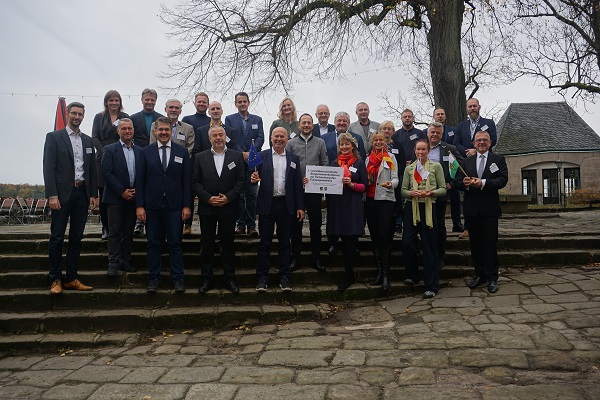 On Friday, mayors from municipalities on both sides of the border met in Hohnstein for a networking meeting. It was the second meeting of this kind after April. The conference was organized and initiated by the Saxon Switzerland Economic Initiative. The aim is to better network communities and cooperate on cross-border projects. The first meeting took place in Krásná Lípa. The second meeting was also attended by District Administrator Michael Geisler, the Czech Consul General in Dresden Mark´´éta Meissnerová, the managing directors of the Euroregions Elbe/Labe and Nisa/Neiße, Rüdiger Kubsch and Ondřej Havlíček, representatives of the Saxon Switzerland and Bohemian Switzerland tourism associations and a representative from German-Czech Future Fund.
"The great interest shown by the mayors shows us the importance of this event. We aim to repeat these meetings twice a year in the future," announced the mayor of Hohnstein and host, Daniel Brade.