

Weekly review no. 26
28.03.2024
The Czech Republic celebrates Easter with a giant Easter egg
Easter is not only just around the corner, but in Jablonné v Podještědí, Czech Republic, it is a huge Easter egg in the middle of the main square. Only six kilometers from the border with Saxony, it has become a tourist attraction in recent days. Photos with the egg are eagerly shared on social networks. “The egg was made by eager craftsmen in the Heřmanice district in 80 hours of after-work work,” says Mayor Jiří Rýdl. It is around three meters high and is probably the largest egg around. It consists of a steel wire mesh through which willow branches and colored fabric panels have been woven. “We had already set it up last year, but only as a pure wire mesh. So the decorated Easter egg is a first,” the mayor continued. It can still be admired at least until Easter Monday. “We will definitely not take it down again on Tuesday, but will leave it there for a few days after Easter,” says Rýdl, given the great interest.
The Easter egg also has a tradition that is still alive today in the Czech Republic. It is considered a symbol of fertility. Colorfully decorated in many variations, it was traditionally presented on Easter Monday by women to men as they moved from house to house.
Railway lines are coming back to life
The tourist railway lines start the new season in the neighboring country on Good Friday. This also applies to train routes that are closed during the rest of the year. This applies, for example, to the popularly known Goat Railway from Děčín to Telnice, the Opárno Express from Litoměřice to Chotiměř in the Bohemian Central Mountains or the route from Ústí-Střekov to Zubrnice, which is also known as a museum village. The trains run on weekends and public holidays and the Elbe-Labe ticket is valid. Historic trains are used on most routes. The Elbe-Labe ticket is also valid on the tourist boat lines T91 to T93 on the Elbe from Ústí to Litoměřice or Hřensko. Timetables and other routes for the lines marked with a “T” can be found on the Ústí district website . Although the site is only in Czech, it is possible to navigate on the left via " Železniční linky " (rail lines) and " Lodní linky a přívozy " (ship lines and ferries).
Easter riding in Mikulášovice
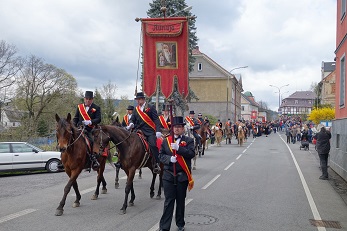
On Easter Sunday the Easter riders are also out and about among our Czech neighbors. The custom, which has been practiced again in Mikulášovice for several years, is originally a tradition of the German minority that still lives there. The procession with the horses starts immediately after Holy Mass, which begins at 10 a.m. in the Church of St. Nicholas.
NGOs criticize housing situation in Prague
Several Czech non-governmental organizations (NGOs) have published the results of a study that rates the housing situation in Prague as the worst in Europe. Nowhere else is accommodation as unaffordable as in the Czech capital, the study says. The NGOs are calling for municipal housing construction, which currently does not exist in Prague, as well as the regulation of rents.
The results of the study, which follows a comparable study in 2018, correspond to the assessment of economist Martin Červinka in the daily newspaper Hospodářské noviny. He points to the increasing purchase prices for private living space and the limited supply, which is further increasing prices. Housing construction had also come to a standstill in the Czech Republic due to skyrocketing construction prices. In addition, the Czech central bank had raised key interest rates significantly more than the European Central Bank, which increased costs for home buyers and also dampened the provision of new living space. The central bank has now made its first interest rate cut. But housing construction has not yet started again. Rents also remain at a high level.
Červinka points to data from the statistics office that Prague has grown by 100,000 residents in the last two years. Cell phone data suggests the number of residents is even higher than the official 1.38 million. The main reason behind this is the influx of Ukrainian refugees in recent years. At the same time, Červinka also viewed the situation positively. It is remarkable how the housing market has accommodated the influx of so many people in such a short time.
 The creation of this newsletter is co-financed by tax revenue based on the budget approved by the Saxon state parliament.