

Derweil in Tschechien... 2/25
10.01.2025
New bird park on a spoil tip
The Czech Ornithological Society (ČSO) is developing a large bird park on a spoil tip near Most under the name "Střimická výsypka", which commemorates the village of Střimice that disappeared under the spoil tip. It has an area of 251 hectares to the east of Most Lake at its disposal, which it was able to acquire in its entirety. The costs of around Kč 30 million are being financed by EU funding from the Just Transition Fund and private donations from over 2,000 people.
So far, the slag heaps have been a poor area in terms of flora and fauna. But this is precisely where the potential lies, as large areas can be created from a single source. In addition to forests, e.g. warmth-loving sparse oak forests, there will be many grazed open areas, wetlands, reed beds and an orchard. It is hoped that this will attract the hoopoe, which is the park's heraldic animal, among a wide variety of species. The park will also be connected to the nearby Most Lake, attracting people for recreation and education. The first visitor tours are already planned for this year.
New visualization of the Dresden-Prague high-speed railway line
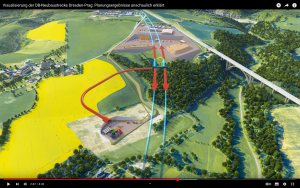
Deutsche Bahn has published a new video visualizing the current planning status of the Dresden-Prague high-speed line. A whole series of details along the route between Dresden and Ústí are explained and clearly illustrated.
Unfortunately, you have to ignore the pronunciation of the place name Chabařovice. This is not a sign of good cross-border cooperation.
Renovation of the hospital in Rumburk begins
This year, the Ústí district will begin renovating the hospital in Rumburk. It took over the hospital from the town of Rumburk a few years ago, saving it from bankruptcy and closure. The hospital is the only one for the approximately 55,000 inhabitants in the Schluckenau region and has been under discussion for many years. 400 million Kč (approx. €16 million) was allocated in the district's budget for the initial work.
In view of the threat of closure at the time, some mayors and senators from the Schluckenauer Zipfel have been making serious efforts to open the hospital in Sebnitz (and Ebersbach at the time) to Czech patients for seven years now. However, the Czech health insurance companies have always refused to cover the costs in a simple and reliable procedure. In this respect, there was some movement in Czech legislation last year. It will be interesting to see whether the pressure on the Czech government in this matter will ease now that the domestic hospital is starting to be renovated.
Rents in the Czech Republic
A study by Deloitte based on data from real estate portals shows that the average rent in all Czech district towns rose in the 3rd quarter of 2024 and is now 310 Kč/m² (approx. €12.40). Unfortunately, no information was available, but it can be assumed that this refers to the warm rent.
The leader is of course Prague with an average of 422 Kčč/m² (approx. €17), with Brno in second place at 361 Kčč/m² (approx. €14.40). This is followed by most other district cities with values between 250 and 300 Kč/m² (approx. €10-12).
In the lower places are the "usual suspects": Karlovy Vary, Ostrava and Ústí nad Labem, which brings up the rear at just 203 Kč/m² (approx. €8). Low housing rents are not necessarily bad in themselves, but in these cases they point to social problems and thus fit into the picture that the three districts present in many statistics on social and economic indicators.
Deloitte divides the housing market into "brick houses", prefabricated buildings and developer projects (i.e. presumably modern new builds). While the average rents for the former are close to the overall average, prefabricated buildings are around 15% cheaper, while developer projects are around 20% more expensive.
Czech Republic imports more electricity from Germany
Last year, the Czech Republic imported more electricity from Germany than it exported for the first time since 2020. This was calculated by the newspaper Hospodářské noviny based on data from the Czech Energy Supervisory Authority (until November) and the Federal Network Agency. According to this, 8226.9 GWh were transported from Germany to the Czech Republic and 4352.8 GWh in the opposite direction, which means a net German surplus of 3874.1 GWh.
The order of magnitude of imports and exports is primarily determined by the electricity prices on the exchange. It is therefore not possible to conclude from the statistics that the Czech Republic produced too little electricity or that Germany produced too much. On the contrary, Germany mainly imported electricity from France, Denmark and Switzerland, while the Czech Republic exported to Slovakia and Austria. This fluctuates greatly over the course of the year, depending on the supply of electricity (e.g. whether wind and sun are delivering) and demand (e.g. whether little electricity is needed for heating in France in summer, but the nuclear power plants are still running), writes Hospodářské noviny.
If you would like to receive our weekly review regularly in your email inbox, sign up for our newsletter.
To the newsletter registration