

Derweil in Tschechien... 12/25
28.03.2025
Highway tunnel completely closed for a week from April 1
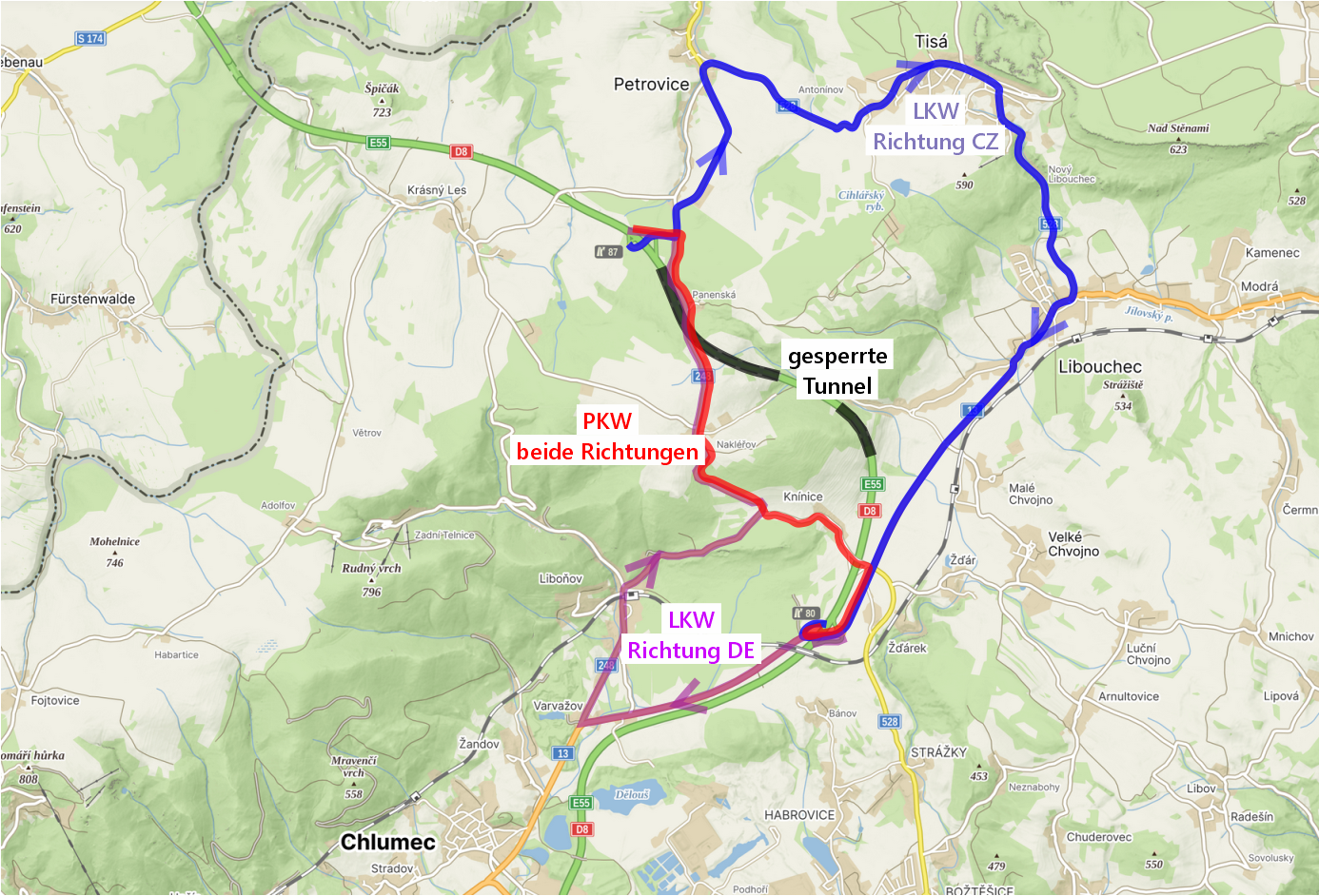
The two tunnels on the D8 highway just over the border (Panenská Tunnel and Libouchec Tunnel) will be completely closed for a week from April 1. The reason for this is repair work in the tunnels. As up to 30,000 vehicles a day are usually counted on this section, traffic chaos is expected in the surrounding area.
Some of the possible roads to avoid the closure are very narrow. Two separate detour routes have therefore been designated for freight traffic (and buses): For journeys in the direction of the Czech Republic, you have to exit in Petrovice and then wind your way through Petrovice, Tisá and Libouchec to rejoin the highway at the Telnice slip road (no. or km 80). In the opposite direction, leave the highway at this exit and drive via Varvažov, Telnice and Nákleřov to the Petrovice slip road. The police will deploy a larger force to ensure that trucks and buses adhere to this regulation and that oversized vehicles avoid the area on completely different routes.
A shorter route is available for cars: After the Petrovice exit, turn right and drive via Nákleřov and Telnice, but then not to Varvažov, but by turning left after the sharp bend via Knínice to the Telnice slip road back onto the highway. This route works in both directions.
It is the route over the Nollendorf Pass, which was also used by Napoleon's troops. Today, you can take the opportunity to stop off in Nollendorf (Nákleřov) at the rustic U Johnů inn, which was called U Napoleonu until a few years ago.
Twelve new INTERREG projects approved
 Twelve new projects were approved last week in the INTERREG program Saxony-Czech Republic 2021-2027 with a total funding of 8.9 million euros. In detail, these are the following projects (with funding amount)
- Network for railroad innovation with SME participation in the border region Erzgebirge/Krušnohoří (821,833.81 euros)
- Ability to determine unknown heat flows in small and medium-sized production facilities (913,931.61 euros)
- NET4DIGI: Saxon-Czech cooperation network for the digitalization of SMEs (652,526.45 euros)
- Deepening cross-border cooperation between SMEs in the Liberec region and Saxony (EUR 219,023.75)
- For themselves since 1875, together in the future / Oberwiesenthal and Kovářská (749,329.60 euros)
- Rescue service without borders (227,362.16 euros)
- Solving environmental risks in post-mining landscapes (551,601.24 euros)
- Soccer verein(t) - Inclusion project of Chemnitzer FC and FK Banik Most-Sous (708,194.26 euros)
- Making the surrounding countryside a tourist experience (979,995.34 euros)
- From Athena to garden gnomes / Děčín and Pirna museums (330,318.31 euros)
- Childhood and education in the aristocracy and bourgeoisie from a historical perspective (834,757.88 euros)
- Landscape and man - live and virtual in the museum (1,965,932.00 euros)
Anyone wishing to find out more about the individual projects is welcome to take a look at the minutes of the committee meeting (PDF).
The program provides around 142 million euros from the European Regional Development Fund (ERDF) for cross-border projects in the areas of innovation and competitiveness, climate change and sustainability, education, lifelong learning, culture and tourism as well as partnership cooperation. To date, a total of 80 projects have been supported with funding amounting to around 96 million euros.
Czech Republic seeks bone marrow for little Madlen
The case of Madlen, who is almost two years old, made the headlines in the Czech media: the girl suffers from aplastic anemia, a disease in which the production of blood cells is severely impaired. One of the consequences is a very weak immune system, which is why Madlen is isolated in a sterile environment in hospital and only her parents are allowed to see her in special protective clothing. A bone marrow transplant could provide a cure, but it is very difficult to find a suitable donor. Even her three sisters are not suitable.
After the father publicized the case on social media and further reports followed in other media, people in the Czech Republic are now flocking in large numbers to the donation centers and registering with one of the two relevant registries. The registry for cell donations in Prague is receiving hundreds of applications per day, whereas normally there would only be a handful. Last weekend, the registry received as many applications as it normally does in four months. In total, over 2000 people have registered in the last two weeks. In the meantime, donors are being recruited in various regions of the Czech Republic who can provide a DNA sample at local facilities. We can only hope that the search is successful.
Acute measures against foot-and-mouth disease
Foot-and-mouth disease is currently spreading in Hungary and Slovakia. Although this disease is not dangerous for humans, for many animals such as cattle, pigs and other hoofed animals it is a serious burden and sometimes fatal. Sick animals are usually slaughtered. The highly contagious virus can very easily be carried into the stables by humans via shoes, clothing or vehicles.
A few weeks ago, the Czech Republic therefore issued an import ban on livestock and animal products from Slovakia and Hungary. This week, the measures were tightened: all animal transports between Slovakia and the Czech Republic will be restricted to four border crossings. These will be equipped with disinfection facilities for vehicles over 3.5 tons. The fire department assumes that it will be able to decontaminate 250 vehicles per hour. As of today, the ban on animal imports also applies to Lower Austria and Burgenland, as a new outbreak in Hungary has spread to Austria.
Other measures to limit the risk of the disease include the closure of wild animal enclosures to prevent infection and a general ban on entering fields. Workers will still be able to enter the fields, but will have to pass a disinfection threshold. So far, the measures seem to be working in the Czech Republic, at least no cases of foot-and-mouth disease have occurred. At the same time, the responsible minister said that not everything was as it should be in Slovakia.
Environmental disaster after serious train accident
On 28 February, a freight train carrying more than 1000 tons of benzene derailed near Hustopeče nad Bečvou in the east of the Czech Republic due to excessive speed and caught fire. The actual accident was quickly brought under control by the fire department. It will be more difficult to get the resulting environmental disaster under control. Czech Environment Minister Petr Hladík described the accident as the largest of its kind in the world, which will take several years to clean up and cost hundreds of millions of crowns.
Around 400 cubic meters of the highly flammable, highly toxic and carcinogenic benzene is believed to have leaked during the accident. However, experts are trying to prevent it from spreading into the groundwater by building barriers. These are erected at a depth of up to seven meters between the accident site and the lake. However, benzene has now also been detected in the wells of a cottage settlement. The groundwater is therefore contaminated and the pollution is spreading towards the Bečva River. The contaminated soil at the site of the accident must now be removed as quickly as possible.
The situation is not helped by the disputes between the Minister of the Environment and the responsible Hejtman of the Olomouc district. The former - like the local mayor - is pushing for the declaration of a state of danger, which would facilitate and speed up processes. The Hejtman rejected this for a long time and only declared a state of danger today at midday. A possible reason for this could be the different party affiliations of the two men, especially in view of the upcoming parliamentary elections in the fall. ČT24, for example, suspects that the construction of the underground protective wall and the removal of the soil could have already begun without this dispute.
If you would like to receive our weekly review regularly in your email inbox, sign up for our newsletter.