

Meanwhile in Czechia... 29/26
24.07.2026
Škoda Defies the Trend at Volkswagen
Škoda, the Czech automaker that is part of the Volkswagen Group, increased both revenue and profit in the first half of 2026, while Volkswagen in Germany is suffering losses and has announced massive job cuts. This is according to the half-year financial report published today.
At Škoda, revenue rose from 15 to 16 billion euros, and profit increased from 1.29 to 1.37 billion euros. This was primarily due to the electric models Elroq and Enyaq. Overall, Škoda sold approximately 630,000 vehicles, an increase of about 8% compared to the same period last year.
Volkswagen in Germany is facing a major restructuring due to declines in revenue and profit. Škoda Auto announced this month that this would have no direct impact on its own operations. However, concerns have already been raised in the media that Škoda’s profits could be used to offset Volkswagen’s losses in Germany.
Škoda vs. Škoda
 For historical reasons, there are two companies named Škoda in the Czech Republic: the aforementioned and better-known automaker Škoda Auto, headquartered in Mladá Boleslav, and the company Škoda Transportation, headquartered in Plzeň (Pilsen). The latter primarily manufactures rail vehicles and buses. Both companies have shared the logo featuring the winged arrow until now, but not for much longer. A spokesperson for Škoda Transportation announced this week that, starting in June 2029, this logo will be used exclusively by Škoda Auto. A basic agreement on this was reached in 2022, and the timeline has now been announced. The new logo for Škoda Transportation is set to be unveiled in the spring of 2028.
Czech Republic Found Guilty of Human Rights Violations
The Czech Republic was recently found guilty by the European Court of Human Rights in two cases, both of which concerned the rights of Roma.
One case concerned the death of a 46-year-old Romani man, Stanislav Tomáš, in Teplice during a police operation in 2021. He had been causing a disturbance while under the influence of drugs. An amateur video recording shows that the police officers knelt on the man’s neck for several minutes during the arrest. At the time, the General Inspectorate of Security Forces concluded its investigation, finding that the police officers had not committed any criminal offense. After the Czech Constitutional Court dismissed a complaint in this matter in 2023, lawyers from the European Roma Rights Center (ERRC) and the Forum for Human Rights (FORUM) filed a complaint with the European Court of Human Rights.
The ruling, issued two years later, now states that the police officers restrained a vulnerable person in a potentially life-threatening position without properly monitoring his health or responding quickly enough after he lost consciousness. The authorities had neither established an adequate legal framework for the use of the prone position nor ensured adequate training for police officers. As a result, the police violated the right to life.
The second case concerns an attack on Roma by soccer hooligans in Sokolov in 2021. The European Court of Human Rights found that the investigation was insufficient and inadequate and that the Czech authorities had ruled out a possible racist motive. The case is now being handled by the Ministry of Justice.
President Pavel’s Veto
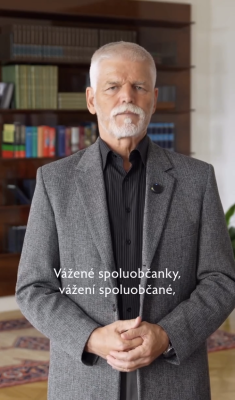
The conflict between the Babiš government and President Pavel, which has been simmering for months, has been reignited. On Wednesday, the president vetoed a bill that would have granted the government broad powers to take on new debt. The president criticizes the bill on several points as going too far and is supported in this assessment by various experts. In a video, Pavel explains his reasons in detail.
The president’s veto has only a suspensive effect and can be overridden by Parliament with a simple majority. This is expected to happen on August 25, which would delay the law by only about a month. Nevertheless, representatives of the ruling parties are criticizing the president extremely harshly and accusing him of abuse of power and demagoguery. This is part of a long series of verbal attacks on the president in recent months, particularly in the dispute over his participation in the NATO summit in Ankara. In this context, the ruling parties are also taking aim at the Constitutional Court, which had provisionally ruled in the president’s favor. Such discrediting of other constitutional institutions is not a good sign in a democracy.
Elbe Barrage Could Be Built Starting in 2029
As the Czech Waterways Administration (ŘVC) recently announced, construction of the barrage near Děčín could begin in early 2029 if the permitting process proceeds according to the planned schedule. The facility could then become operational in 2033. The barrage is intended to improve navigability on the Elbe on the Czech side and will also include a hydroelectric power plant capable of supplying electricity to a large portion of Děčín’s households.
According to ŘVC, navigation conditions on the Elbe are currently extremely unpredictable, as sufficient draft cannot be guaranteed for most of the year, making long-term planning of shipping traffic impossible and leading to a shift in transport to road and rail. A representative of the inland waterway operators explained that in March of this year, they had succeeded in transporting several oversized shipments, some of which had been waiting for transport for nearly two years. However, the situation has reportedly become problematic again since the end of March.
Environmentalists have long protested the construction of the weir. According to ŘVC, however, there are expert studies and analyses demonstrating that the necessary compensatory measures would be technically feasible. In addition to a fish ladder, these include measures to create and preserve natural habitats in the vicinity of the river.
A key point of contention in the entire matter is whether the high investments and environmental impacts are worthwhile, given that the Elbe is often not navigable on the German side anyway. The barrage would only extend navigability on the Czech side by a few kilometers, but it could not guarantee the connection between Czech inland ports and international ports, which the ŘVC cites as its justification.
Sculpture Collapses in Prague
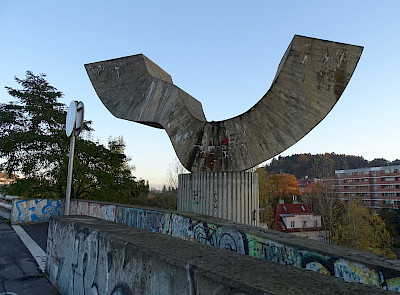 Just like Dresden’s Carolabrücke, the concrete sculpture “Rovnováha” (Equilibrium) in Prague, located next to the Barrandov Bridge, met the same fate last Friday: it collapsed unexpectedly. The sculpture’s lack of stability—despite its name—was already well known, which is why the area beneath it had been cordoned off.
As early as Monday, the Prague City Council decided to reconstruct the work by sculptor Josef Klimeš true to the original and to allocate the approximately 13 million CZK (approx. 530,000 euros) needed for the project. The same construction method used in 1989 will be employed.
Summer Break
Our newsletter is now taking a two-week summer break. You’ll receive the next issue on August 14. Until then, we wish you a wonderful summer.