

Meanwhile in Czechia... 30/26
14.08.2026
The "Hunger Stones" can be seen near Děčín
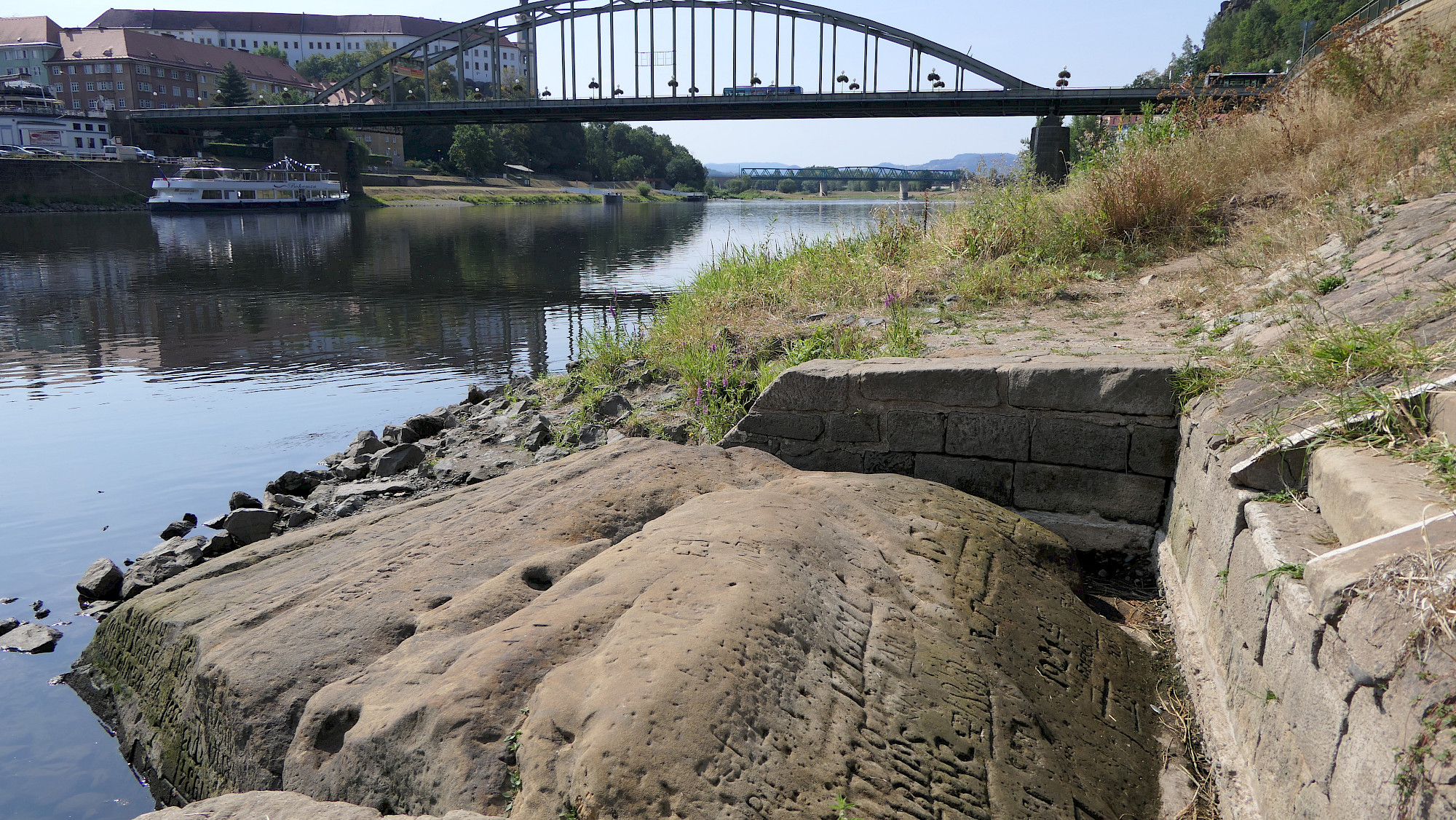
Traditionally, during dry summers, the so-called “Hunger Stones” can be seen along the Elbe near Děčín. These are large stone blocks with engraved inscriptions. Most of these inscriptions record the years when the Elbe’s water level was at its lowest, thereby threatening the local economy. In the past, the Elbe was one of the most important transportation routes, and the people of Děčín were economically dependent on it—hence the name “Hunger Stones.” This phenomenon occurs only on unregulated sections of the river. The last Elbe barrage is located in Ústí nad Labem; although there are modifications downstream (riverbanks, navigation channels), the river flows unregulated beyond that point.
The Elbe Water Authority (Povodí Labe) has now had the stones re-identified and cleaned. In the process, an employee even found a “new” Hunger Stone in Děčín. The stone has actually always been there, but the inscriptions were no longer legible, and the stone had apparently fallen into oblivion. Two dates (1934 and 1947) are engraved on it—two classic drought years that also appear on other stones. In addition, the name of the person who engraved the number 1934 is clearly visible: F. Schade. The year 1947 shows that, despite the expulsion of a large part of the original population after World War II, the “Hungerstein” was still well known. It apparently only fell into oblivion afterward. Such stones can also be found near Hřensko. Employees of Povodí Labe counted a total of 15 stones there.
Today, the economic situation is no longer threatened due to alternative transportation routes. However, the drought is also taking its toll on the Czech Republic. This affects not so much the already decimated cargo shipping traffic as it does agriculture and the flora and fauna. In addition, the first hydroelectric power plants have been shut down to conserve water. The fact that the water level in Děčín does not fall below 115 centimeters is due to the Vltava Cascades. This system of dams is responsible for ensuring a minimum flow rate of 40 cubic meters per second in the Vltava River, primarily to guarantee an adequate water supply for the capital, Prague. As a side benefit, this also supplies water to the Elbe River, allowing steamboats in Dresden to continue operating to a limited extent.
After all, a historic moment is now approaching at the Vltava Cascades, as the Orlík Dam will soon no longer be allowed to be tapped to prevent the water level from falling below the minimum threshold. The next major reservoir, Slapy, will soon take over. According to historians, this happens only once every 50 years. Nevertheless, there is still enough water in reserve at Slapy.
Saxony Informed About Planned Elbe Barrage
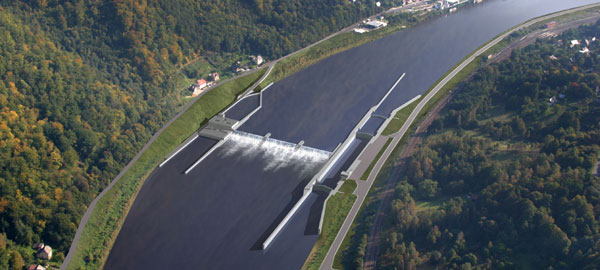
As reported in the last newsletter, the Czech Republic is moving forward with preparations for the construction of a barrage on the Elbe River in Děčín. The required environmental impact assessment is expected to be completed shortly and submitted to the relevant authorities and the public for review.
At the end of July, Czech Environment Minister Igor Červený informed Saxony’s Environment Minister Georg-Ludwig von Breitenbuch, as well as two state secretaries from the Ministries of Transportation and Infrastructure, of this development. According to the Czech daily newspaper Mladá fronta Dnes (MfD), Breitenbuch expressed surprise that the Czech Republic intends to build the barrage after all. Apparently, the Saxon government had not been adequately informed. Saxon media are also reporting significantly less on the Saxon-Czech border region than they did two years ago.
However, according to MfD, both Breitenbuch and Sören Trillenberg, State Secretary at the Ministry of Infrastructure, were impressed by the Czech plans and announced their support. According to the MfD, no details were provided on what form this support might take. This, however, represents a shift in Saxony’s previous policy, which had always viewed the construction of the barrage critically—primarily due to concerns about deteriorating water quality, but also because of its impact on the flora and fauna in the Saxon Elbe region.
The Czech Republic sees the 250-million-euro project as an opportunity to transport more goods by water. The Ministry of Transport cited a figure of up to 4 million metric tons per year. However, this maximum was previously reached only in the 1980s, when there were far more cargo ships than there are today. In the first quarter, a mere 116,000 metric tons were transported on the Elbe. Germany cannot guarantee the water levels demanded by the Czech Republic almost year-round, and the construction of barrages on the German side has been ruled out.
There is also hope that the water table will rise in the area where the water is impounded. The barrage is insignificant for water retention—which is crucial during this drought—because its storage capacity is far too small for that purpose.
The Czech National Audit Office, which oversees the use of taxpayer funds, has also criticized the wisdom of the new construction in the past. Critics view the investment sum of 250 million euros as too low, since the Czech Republic has used this figure in the past, while prices have since risen sharply in almost all sectors.
Majority in Favor of Cell Phone Ban in Schools
Eight out of ten Czechs support a ban on cell phones in schools. This was the finding of an opinion poll conducted by the firm Median for Czech Radio in early August. Of more than 1,000 respondents, 78 percent supported the ban, primarily parents and the older generation. Among young people, the proportion of supporters was just under 50 percent. However, three-quarters of all respondents also agreed with the statement that schools should teach children how to use digital technology.
The Czech Republic plans to implement a cell phone ban starting with the 2027–28 school year. A few weeks ago, the government approved a complete ban on cell phones in kindergartens, elementary schools, and the lower grades of multi-year high schools and conservatories. The ban applies not only during class but also during breaks, after-school care, and in the cafeteria. However, schools may permit the use of digital tools for instructional purposes. The law must now be passed by Parliament and signed by the President.
However, such a ban is already in effect at 90 percent of schools, which is why the opposition has described the law as pure activism. “A blanket ban solves nothing. What matters are individualized, enforceable solutions from schools and cooperation among schools in this area.”
Setback for the Ziegenbahn
The Central Planning Commission of the Ministry of Transportation has spoken out against the renovation and reopening of the final section of the railway line from Děčín to Oldřichov u Duchcova. The costs, estimated at around 300 million crowns (12.5 million euros), would be too high. Due to limited funds, more important lines would have to be renovated first. In contrast, only seasonal tourist service is planned for the line, which is popularly known as the “Goat Railway.”
The section in question is the 8.5-kilometer stretch from Krupka město (Graupen Stadt) to Oldřichov, which is currently not operational. Since 2022, the Ústí District has been operating a tourist service from Děčín initially to Telnice, which was extended to Krupka in 2024. The service is well-utilized, which is why the district expects the opening of the final section to also boost tourism. It also offers a stop in Teplice (Lesní brána Station – Forest Gate) and, with smart connections to other transportation options, would increase the appeal of the Teplice region. Even today, passengers can transfer in Krupka to the chairlift up to the Mückentürmchen.
The Ústí District is therefore not giving up yet. The district government is continuing the policy of the previous administration. And even the Ministry of Transportation has not yet closed the door. Officials noted that renovation is not possible “at this time” but expressed openness to a renovation if the Ústí District were to contribute funding.
Schluckenau Residents Worried About Children’s Hospital

About 55,000 people live in the so-called Šluknov Corner, the land promontory jutting into Saxony that includes towns such as Rumburk, Varnsdorf, Mikulášovice, and Šluknov—the small town that gave the region its name. In recent days, unease has been growing in the region, which is repeatedly threatened with being left behind by the rest of the country. Currently, these fears center on medical care for children, as the pediatric clinic at the hospital in Rumburk is set to close. The daily newspaper *Děčínský deník* reports on this. There has not yet been any official confirmation from the operator, *Krajská zdravotní*, a hospital network under the jurisdiction of the Ústí District. However, staffing shortages are cited as the reasons for a possible closure. The clinic’s long-time director is retiring. Parents would then have to take their children to hospitals in Česká Lípa, Děčín, or Liberec for inpatient treatment.
Mayors are organizing protests against a possible closure. The association responsible for the further development of the Schluckenau region is set to address the issue shortly. Above all, everyone is demanding an explanation from the district.
This is not the first time a clinic at Rumburk Hospital has closed. Years ago, the maternity clinic here ceased operations. At one point, the hospital’s very future was in jeopardy when the then-municipal hospital was forced to file for bankruptcy. It was saved by its integration into the Ústí District Hospital Network, which includes, among others, the hospitals in Teplice, Ústí, and Děčín. Other solutions, such as cross-border healthcare at the nearest Saxon hospital in Sebnitz, have so far failed.