

Meanwhile in Czechia... 36/26
25.09.2026
Czech Republic's Northernmost Observation Tower Opens
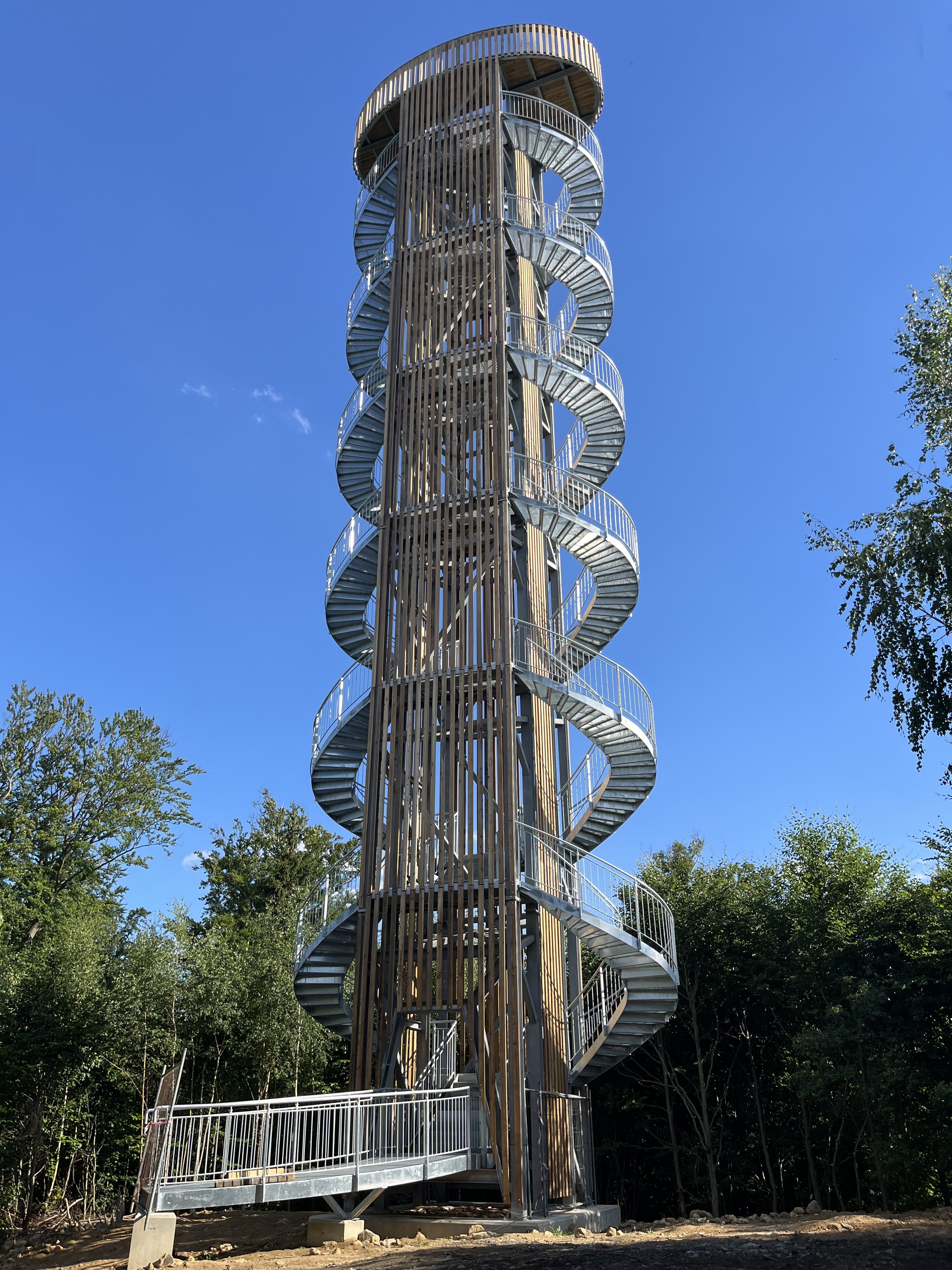
A new observation tower will open on Saturday at the summit of Jitrovník (German: Jüttelsberg). Jitrovník is located west of Šluknov (Schluckenau) near the village of Království (Königswalde) and, at 510 meters, is one of the highest peaks in the Bohemian-Saxon Lusatia region. The 31-meter-high steel structure with wooden cladding, designed by architect Tomáš Beneš, promises sweeping views and new perspectives. This is because there has been no comparable observation tower in this area until now.
Things were different over 120 years ago. Back then, there were even more towers in the Schluckenau region. Until 1903, a viewing tower made primarily of wood stood on Jitrovník. The new viewing tower is therefore the first to be built in the Schluckenauer Zipfel since 1905. The last new tower built at that time was the one on Mount Tanečnice (Tanzplan) near Mikulášovice. However, the tower on Jitrovník is now the northernmost observation tower not only in the Schluckenauer Zipfel region but in all of the Czech Republic.
The cost of the new tower, amounting to 13 million crowns (540,000 euros), was largely covered by EU funds secured through a joint project with the town of Sohland. The tower is located near the border with Saxony and is also easily accessible via marked trails from Ebersbach or Taubenheim. A festive program is planned for the inauguration on Saturday.
Price of Czech Highway Vignette to Remain the Same
Good news for everyone traveling by car in the Czech Republic. The price of highway vignettes will not increase at the beginning of next year. The Czech Parliament passed an amendment to the Land Transportation Act, which previously provided for an annual increase starting in January of the following year. This means that prices in 2027 will remain at the previous year’s level. The annual vignette costs 2,570 korunas (107 euros), the monthly vignette costs 480 korunas (20 euros), the 10-day vignette is still available for 300 korunas (12.50 euros), and consumers pay 230 korunas (9.60 euros) for one day of highway use. The amendment also changes the validity period of the daily vignette. It is now valid for 24 hours from the time of purchase and no longer just until midnight on the day of purchase, as was previously the case.
The previous government had introduced a mechanism that caused the price of vignettes to rise annually. Electric and hydrogen-powered cars do not require vignettes (but must be registered in the Czech Republic). A reduced price applies to cars powered by natural gas or biomethane, as well as to plug-in hybrids. The vignette—which has been available only in digital form in the Czech Republic for years—can be purchased centrally via the government website edalnice.cz.
Václav Havel Library Gets a New Name
The Václav Havel Library has renamed itself the First Presidential Library. This move by the new board of directors came in response to the decision in June by the president’s widow, Dagmar Havlová, to withdraw her consent to the use of Václav Havel’s name. Havlová had also completely withdrawn from the library, which she had co-founded in 2004.
For nearly 20 years, the library had preserved the legacy of the first freely elected president of Czechoslovakia and the Czech Republic following the Velvet Revolution of 1989. To that end, it organized a packed program featuring an average of four events per week. The library provided a platform for eyewitnesses as well as historians, artists, and politicians. It organized exhibitions, presented publications, and collaborated with schools.
However, at the beginning of the year, a deep rift developed between the then-new director, Tomáš Sedláček, and the staff, resulting in the entire team resigning, including the long-time program director, writer, and co-signatory of Charter 77, Jáchym Topol. Sedláček was later temporarily suspended from duty. But by then, the most important sponsors—and subsequently Dagmar Havlová as well—had already withdrawn their support.
The library now hopes to continue its previous work under a new name and with a new staff. Among the new board members are associates of Václav Havel, such as the musician Michal Kocáb. Sedláček, on the other hand, was permanently dismissed after only two years on the job.
But the question remains whether the library’s work can continue at the same level as before. New sponsors are reportedly on board. But the naming rights are gone for good. Dagmar Havlová transferred them to the Prague City Library earlier this week. However, the library does not have a dedicated Václav Havel section; so far, there have been only a few events planned to mark the upcoming 90th birthday of the writer and president. It also remains unclear what will happen to the archives of the former Václav Havel Library.
Prague Funicular Resumes Operation After Renovation
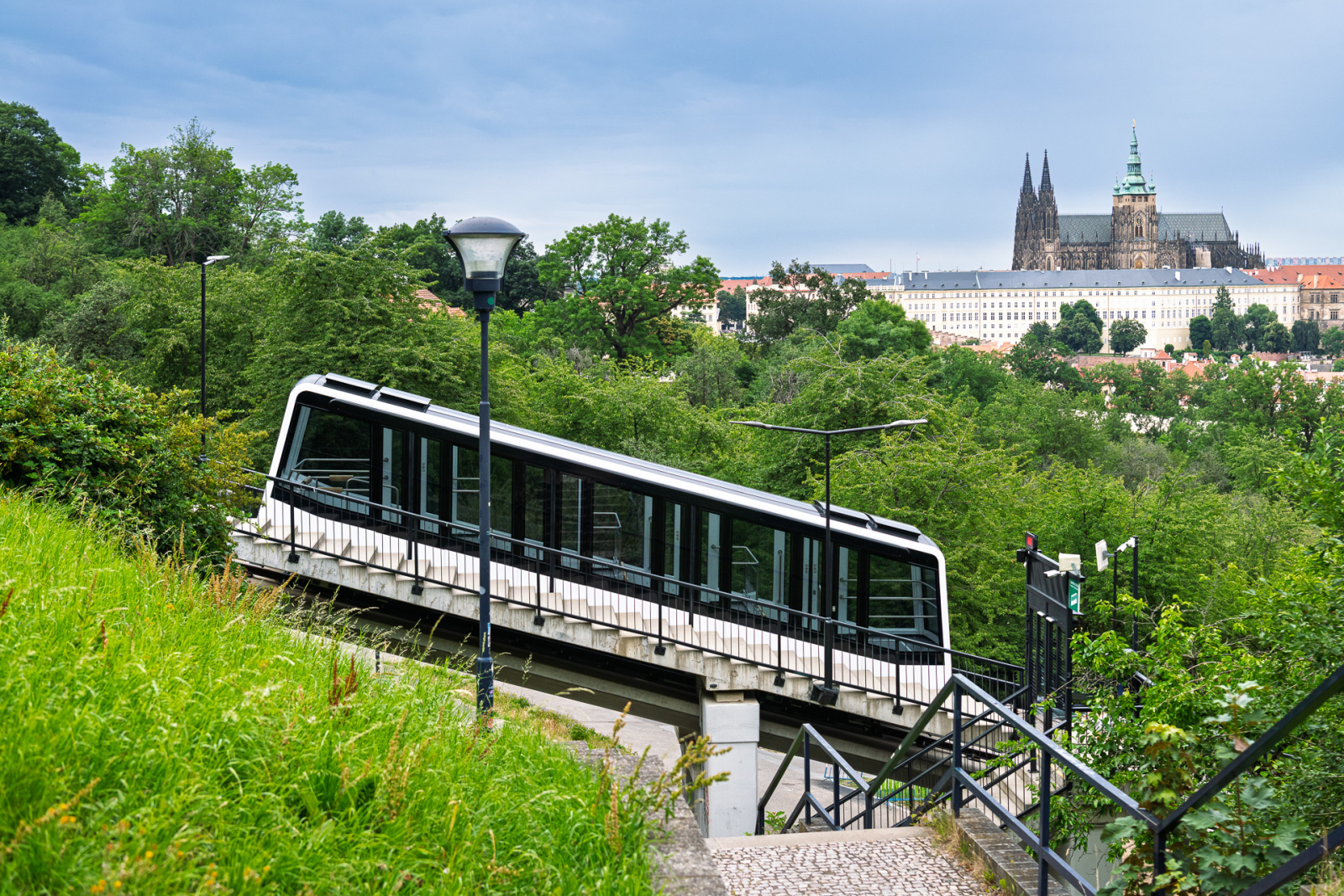
The Prague funicular to Petřín Hill (Laurenziberg) resumed service on Monday morning after a two-year renovation break. Contrary to expectations, the rush to ride the funicular was limited. According to Prague Public Transport, this was likely due to the early start time of 7 a.m. The funicular is an integral part of the capital’s public transit system and operates daily between 7 a.m. and 10:15 p.m., running every 10 minutes. However, if demand spikes, the intervals may be shortened.
Over the past two years, it wasn’t just the cable car line that was renovated; the slope also had to be stabilized. New cars are now in service. They were designed by Anna Marešová, a graduate of the University of Ústí nad Labem (Aussig), who also designed the new cable car to Ještěd (Jeschken) near Liberec (Reichenberg). The new cable car has larger windows, offering better views. It also has a capacity of 120 passengers. Previously, the limit was 100 passengers. The cable car was built by the Austrian-Swiss consortium Doppelmayr/Garaventa. The acquisition cost was 137.7 million crowns (5.7 million euros).
The cable car will operate on a trial basis until August 2027. Until then, a staff member will be present in the cabins. Although the cable car is remotely controlled from the upper station, in the event of an accident or malfunction, on-site staff can coordinate further action in consultation with the control center.
With the launch of the service, the price of a single ride has increased from 60 to 100 crowns. Those who purchase a ticket via the Prague Public Transport Company app pay only 90 crowns. The cable car can still be used with pass cards or 24- and 72-hour tickets. Children up to age 15 and adults 65 and older ride for free.
The Czech Republic is also delighted with the Vindobona
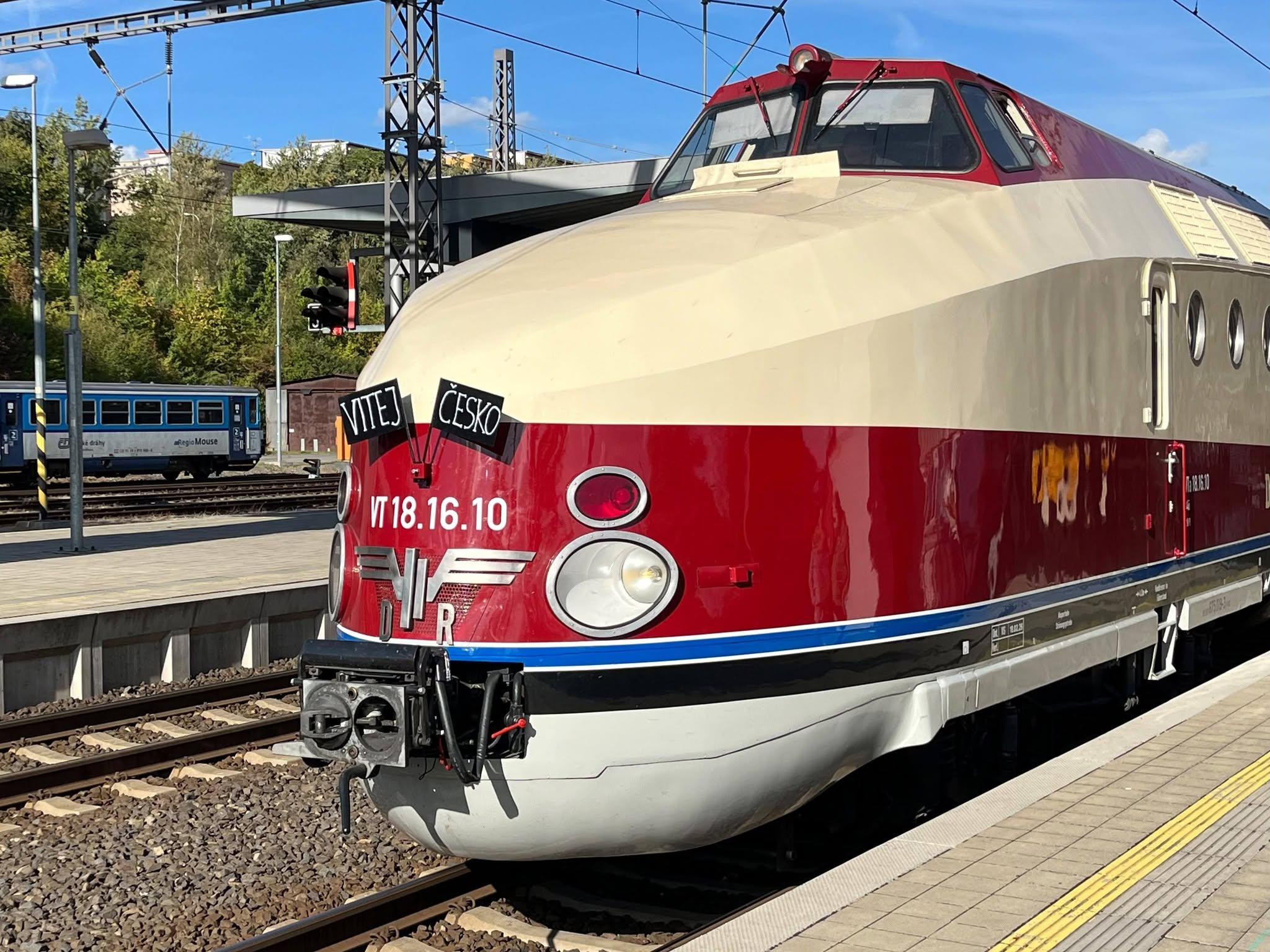
The historic Vindobona express train has completed its first trip to the Czech Republic. However, the journey wasn’t entirely without incident. The high-speed railcar (SVT), formerly known as the VT 18.16, was forced to take a detour. Due to a coupling failure, the train did not return as planned via Liberec and Hrádek nad Nisou, but instead traveled through the Elbe Valley on the right bank of the Elbe via Štětí, Ústí nad Labem-Střekov, and Děčín. It attracted a great deal of interest along the entire route; videos and photos are flooding the internet, daily newspapers, and social media.
In the Czech Republic, this iconic train—which was formerly used in international passenger service in the GDR and has been painstakingly restored in recent years—is actually known by a different name. Since many trains and locomotives in the Czech Republic are named after animals, the Czech nickname comes as no surprise: Because of its front end, it is called “Dolphin.”
Monday is a national holiday in the Czech Republic
On Monday, the Czech Republic celebrates its national day. The country commemorates its patron saint, Saint Wenceslas. On September 28, the saint—whose equestrian statue stands at the upper end of the large square named after him—was murdered.
In the Czech Republic, this holiday is one of those days when stores remain closed. Exceptions include stores with less than 200 square meters of retail space and gas stations. However, it is likely that even smaller stores will remain closed or at least adjust their hours. Cafés and restaurants will operate on their usual Sunday hours. Museums, castles, zoos, and other recreational facilities, however, will be open.